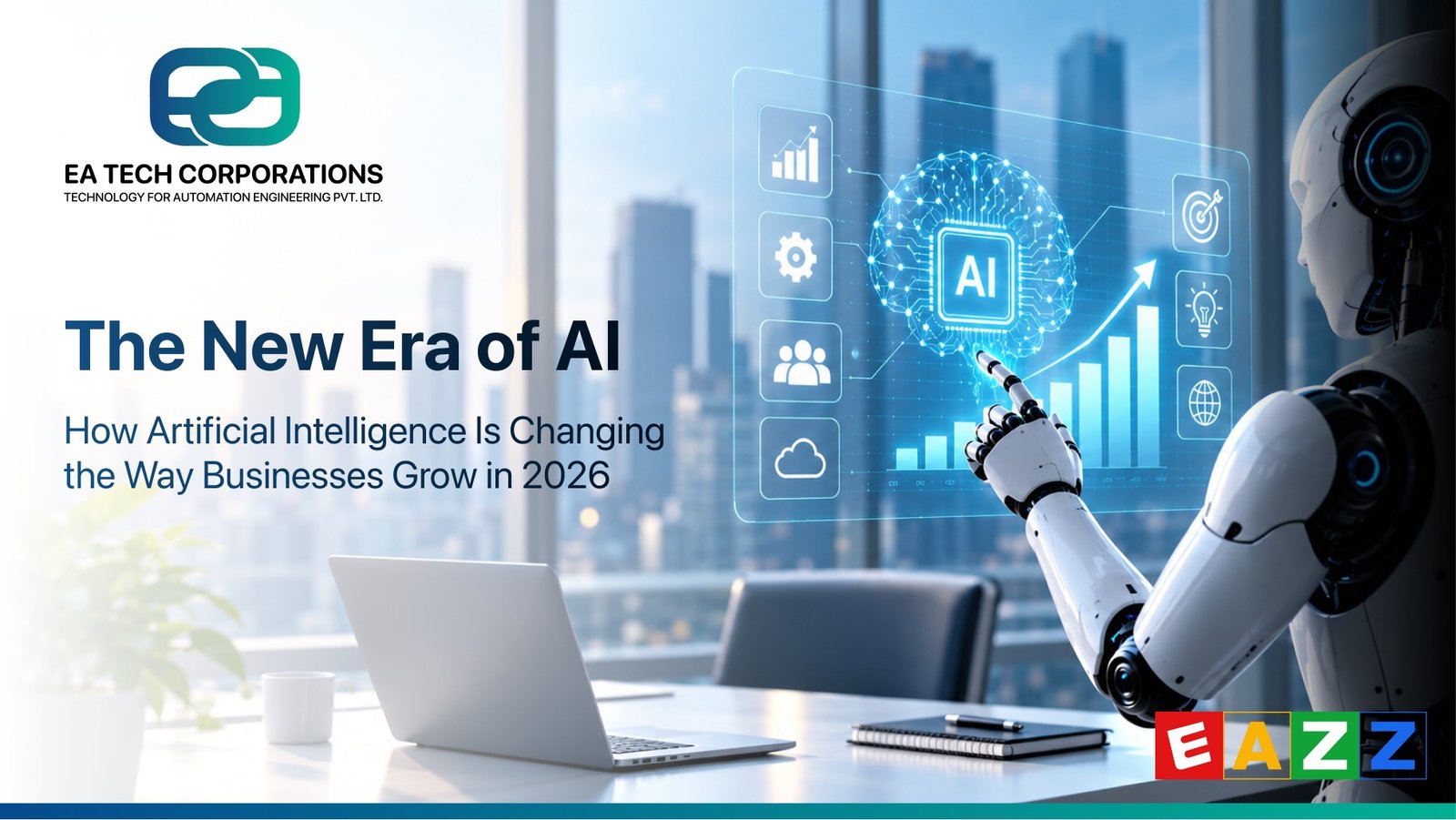
Artificial Intelligence is no longer a technology reserved for large technology companies or research laboratories. In 2026, AI is becoming a practical business tool that can influence how companies sell, communicate, operate, analyze information, and serve customers.
The important question has changed.
It is no longer simply, “Should my business use AI?”
The better question is:
“Where can AI create measurable value in my business?”
That shift represents the beginning of a new era.
Businesses are increasingly moving beyond experiments with chatbots and content generation toward AI integrated directly into everyday workflows. Recent research and industry developments show growing interest in agentic AI, automation, customer service AI, and AI-powered business processes.
For businesses willing to adopt it strategically, AI can become more than a productivity tool. It can become a growth engine.
What Is New in AI?
The biggest change in AI is the movement from AI that answers to AI that acts.
Traditional AI systems generally respond when a person gives them an instruction. Newer AI agents are designed to handle sequences of tasks, use information from different systems, make decisions within defined boundaries, and complete workflows with less human intervention.
For example, imagine a potential customer submitting an enquiry through a website.
A conventional system may simply store the enquiry.
An AI-powered business system could:
This is the difference between using AI as a tool and building AI into the business process.
1. AI Agents Are Becoming the Next Business Interface
One of the most important developments is agentic AI.
An AI agent can be designed to perform a specific business objective rather than simply generate an answer.
For example:
This doesn't mean businesses should remove people from every process.
Instead, the strongest approach is often human + AI collaboration.
AI can handle repetitive activities while employees focus on relationships, strategy, creativity, negotiation, and decisions requiring judgment.
2. Generative AI Is Moving Beyond Content Creation
Generative AI initially became popular because it could create text, images, presentations, code, and other content.
But its business potential is much broader.
Companies can use generative AI for business to:
- Summarize documents
- Analyze customer conversations
- Create marketing drafts
- Generate reports
- Extract information from documents
- Support employees with internal knowledge
- Prepare sales proposals
- Assist software development
- Personalize customer communication
The real value comes when generative AI is connected to a company's data, applications, and workflows.
A standalone AI chatbot may be useful.
An AI assistant connected to the right business information can be significantly more valuable.
3. AI Can Make Customer Service More Intelligent
Customer expectations are changing rapidly.
People increasingly expect quick, relevant and personalized responses.
This is creating a major opportunity for AI customer service.
AI-powered systems can provide support outside traditional working hours, answer frequently asked questions, classify customer requests, summarize conversations and route complex issues to human employees.
According to Gartner's 2026 research found that customer-service leaders are significantly increasing AI spending, with generative AI chatbots, voicebots and agentic AI among the technologies expected to deliver substantial future value.
The important point is that AI should not simply be used to reduce human interaction.
It should be used to make human interaction better and faster.
4. AI Can Turn Business Data Into Business Intelligence
Most companies already have valuable information.
The challenge is finding meaning in it.
Sales records, customer enquiries, invoices, website activity, service records and operational data can contain patterns that are difficult to identify manually.
AI-powered business analytics can help businesses identify:
- Which products perform best
- Which customers are most valuable
- Where sales opportunities are being lost
- Which processes consume excessive time
- Where operational problems repeatedly occur
- What customer behaviour is changing
This creates an important shift:
Data tells you what happened. AI can help you understand what to do next.
5. AI Can Help Small and Medium Businesses Compete
AI is not only for enterprises with enormous technology budgets.
For SMEs, the opportunity can be even more interesting.
A smaller company may not have large departments for marketing, customer support, data analysis, IT and operations.
AI automation for small business can help extend the capabilities of a smaller team.
For example, one employee supported by automation may be able to handle tasks that previously required several hours of repetitive manual work.
This can improve:
Productivity + Speed + Customer Experience + Scalability
Salesforce's 2026 research on Indian SMBs reported strong AI adoption and improvements in areas including productivity, revenue and customer experience among businesses using AI.
6. The Real Advantage Is Not AI Alone
Here is the biggest lesson of the new AI era:
Buying an AI tool does not automatically create business growth.
The advantage comes from solving the right problem.
For example:
Instead of asking:
“How can we use AI?”
Ask:
“Which business process is slow, expensive, repetitive or difficult to scale?”
Then evaluate whether AI can improve it.
This approach produces much better outcomes.
How Can AI Help a Business Grow?
A well-designed AI business automation strategy can contribute to growth in several ways:
Reduce repetitive work
AI can automate routine processes and give employees more time for higher-value activities.
Improve response time
AI can respond to customer enquiries quickly and continuously.
Increase sales efficiency
AI can assist with lead qualification, follow-ups, recommendations and sales analysis.
Improve customer experience
Personalized and faster interactions can help build stronger customer relationships.
Support better decisions
AI can analyze large amounts of information and identify useful patterns.
Scale operations
Automation allows businesses to handle increasing workloads without increasing every cost proportionally.
The Future: From AI-Assisted to AI-Native Businesses
The next stage isn't simply adding AI to existing processes.
It is redesigning processes around intelligent systems.
Industry research increasingly points toward this shift. Businesses gaining the most value from AI are increasingly integrating it into broader workflows rather than treating it as an isolated productivity application.
That means tomorrow's successful companies may not be the ones with the most AI tools.
They may be the ones that design the best AI-enabled workflows.
Conclusion
The new era of AI is not really about machines becoming smarter.
It is about businesses becoming more intelligent, responsive and scalable.
The companies that benefit most will be those that connect AI with real business objectives instead of adopting technology simply because it is trending.
At EA Tech Pvt. Ltd., the opportunity is to help businesses think beyond isolated AI tools and explore how intelligent technology, automation and digital systems can become part of a practical growth strategy.
The future of business isn't simply powered by AI. It is designed with AI.
Ready to explore AI for your business?
Talk to EA Tech Pvt. Ltd. today and discover where AI, automation and intelligent technology can create measurable value for your business.
Contact EA Tech Pvt. Ltd.