
Artificial intelligence is no longer a technology limited to research laboratories or large technology companies. It has become an important business technology capable of transforming how organizations communicate with customers, manage operations, analyze information, automate repetitive work, and make decisions.
In 2026, the conversation around AI has moved beyond simply asking, “Can we use AI?”
Businesses are now asking:
“Where can AI create measurable value for our business?”
This shift is driving demand for modern AI solutions, AI automation, intelligent applications, AI agents, predictive analytics, and generative AI.
For businesses planning their digital transformation journey, understanding these developments is essential.
What Is Modern AI?
Traditional software generally follows predefined rules.
Modern AI systems can analyze information, identify patterns, understand language, generate content, make recommendations, and assist users with complex tasks.
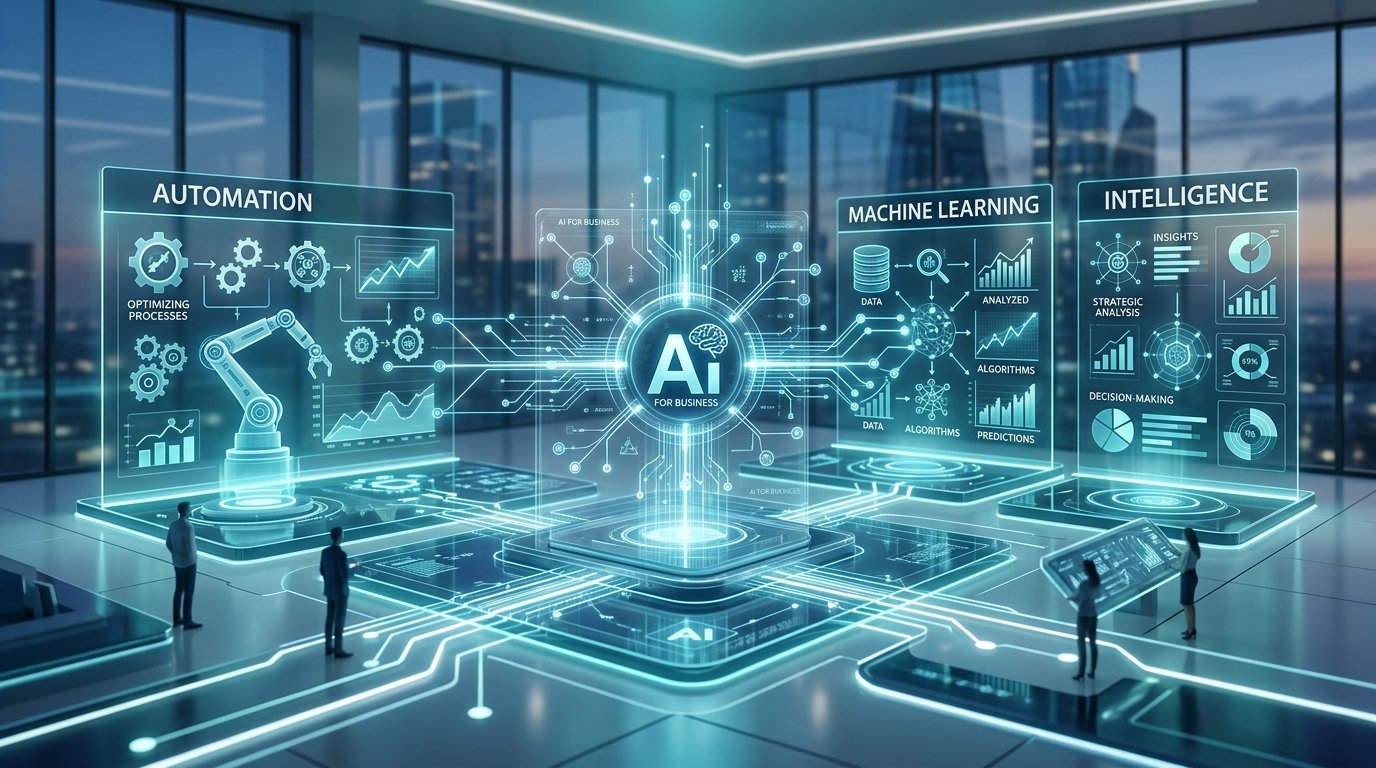
Modern AI solutions combine technologies such as machine learning, generative AI, natural language processing, computer vision, predictive analytics, and intelligent automation.
The objective is not simply to add AI to an existing application.
The objective is to solve a real business problem more intelligently.
For example, an organization could use AI to:
- Analyze customer conversations
- Automate repetitive workflows
- Predict sales opportunities
- Identify unusual transactions
- Generate business reports
- Assist employees with information
- Automate customer support
- Analyze documents
- Recommend next actions
- Improve operational decision-making
This makes AI a strategic business capability rather than just a technology trend.
Why Businesses Are Investing in AI
Businesses operate with enormous amounts of data.
Customer information, transactions, emails, documents, sales records, employee information, operational data, and financial information are generated every day.
The challenge is turning this data into useful decisions.
This is where artificial intelligence solutions can provide significant value.
AI can process large volumes of information much faster than traditional manual methods. It can identify patterns and provide insights that might otherwise be difficult to discover.
For businesses, this can support:
Better decisions + Faster processes + Lower repetitive workload + Improved customer experience
However, successful AI implementation requires more than purchasing an AI tool.
Businesses need to identify the right use case, prepare their data, integrate AI into existing workflows, and establish appropriate security and governance.
The Rise of AI Agents
One of the most important developments in modern AI is the growth of AI agents.
A traditional chatbot generally responds to questions.
An AI agent can potentially go further by understanding a task, using connected tools, retrieving information, and performing actions within an authorized workflow.
For example, an AI sales agent could help:
- Analyze a new lead
- Identify relevant customer information
- Prioritize the opportunity
- Recommend a follow-up
- Prepare a personalized message
- Update the CRM
- Notify the sales representative
This represents a significant change in business automation.
Instead of employees using software to perform every individual step, intelligent systems can increasingly assist with complete workflows.
Generative AI Is Changing Business Communication
Generative AI has become one of the most visible areas of artificial intelligence.
It can help generate text, summaries, ideas, documents, responses, and other forms of content.
Businesses can use generative AI to support:
- Marketing content
- Customer service responses
- Internal documentation
- Meeting summaries
- Proposal preparation
- Product descriptions
- Knowledge management
- Business communication
The key is using generative AI responsibly.
Organizations should establish appropriate controls around confidential information, accuracy, access permissions, and human review.
AI should enhance employee productivity—not introduce unnecessary business risks.
AI-Powered Customer Experience
Customer expectations are changing.
People increasingly expect quick responses and personalized interactions.
Businesses can use AI-powered customer service to provide assistance across websites, applications, messaging platforms, and other digital channels.
AI can help answer frequently asked questions, understand customer requests, summarize conversations, and route complex issues to human employees.
The most effective model is often not “AI instead of humans.”
It is:
AI for speed + Humans for judgment
AI handles repetitive interactions while employees focus on situations requiring empathy, expertise, negotiation, or complex decision-making.
Predictive AI for Better Decisions
Businesses have always used historical data to understand performance.
Modern AI enables organizations to move toward predictive and prescriptive intelligence.
Instead of asking:
“What happened?”
businesses can increasingly ask:
“What is likely to happen next?”
For example, predictive AI can support use cases involving:
- Sales forecasting
- Customer churn prediction
- Demand forecasting
- Fraud detection
- Inventory planning
- Risk analysis
- Maintenance prediction
This can help businesses become more proactive.
Instead of reacting to problems after they happen, organizations can identify potential risks and opportunities earlier.
AI Automation and Business Productivity
Repetitive work is one of the biggest opportunities for AI automation.
Employees often spend significant time performing repetitive activities such as entering information, reviewing documents, preparing reports, responding to routine requests, or moving information between systems.
AI-powered automation can help streamline these activities.
For example:
This creates a balance between automation and human oversight.
The result can be faster processing and more efficient use of employee time.
AI in Different Industries
The applications of AI are not limited to one sector.
Manufacturing
AI can support predictive maintenance, quality inspection, demand forecasting, production optimization, and operational analytics.
Healthcare
AI can assist with administrative workflows, document analysis, scheduling, patient communication, and data-driven insights.
Retail
AI can support personalization, demand forecasting, customer service, inventory intelligence, and recommendation systems.
Logistics
AI can help optimize routes, forecast demand, analyze delivery data, and improve supply chain visibility.
Finance
AI can support anomaly detection, document processing, risk analysis, customer assistance, and financial insights.
Hospitality
AI can improve customer communication, personalization, booking assistance, operational workflows, and service management.
The right AI solution depends on the organization's specific processes and objectives.
Why AI Strategy Matters
Implementing AI without a strategy can create disappointing results.
A successful AI development strategy should begin with the business problem.
Businesses should ask:
- What process takes too much time?
- Where are employees performing repetitive work?
- Where is important data being underused?
- What decisions could benefit from better predictions?
- Where can customer experience be improved?
- What systems need to integrate with AI?
Once the use case is identified, the organization can determine the appropriate AI technology.
This approach is much more effective than adopting AI simply because it is trending.
Building AI Solutions with EA Tech
EA Tech Pvt. Ltd. focuses on helping businesses explore and implement modern technology solutions, including AI and Machine Learning, custom software, cloud technologies, cybersecurity, and digital transformation.
Its AI/ML capabilities include areas such as generative AI, AI-powered CRM and ERP solutions, AI chatbots, workflow automation, machine learning, and AI business intelligence.
This gives businesses an opportunity to approach AI from a practical perspective: identify a business challenge, design an appropriate technology solution, integrate it into existing operations, and measure its value.
About the EA Tech Team
Behind every successful AI implementation is more than an algorithm.
It requires business understanding, software engineering, data expertise, integration capabilities, security awareness, and ongoing technical support.
The EA Tech team brings together technology capabilities across AI and machine learning, modern software development, cloud and cybersecurity, Microsoft technologies, UI/UX, and digital solutions.
This multidisciplinary approach is important because modern AI projects rarely operate in isolation.
An AI solution may need to communicate with CRM systems, ERP platforms, databases, websites, mobile applications, cloud infrastructure, and enterprise workflows.
The EA Tech approach is focused on building technology around real business requirements rather than treating AI as a standalone feature.
What Is Next for AI?
The next phase of AI will increasingly focus on intelligent systems that can understand context, work with business data, interact with enterprise applications, and assist with complete workflows.
The future may move from:
AI that answers → AI that assists → AI that acts
Businesses that prepare for this transition today can create a stronger foundation for future digital transformation.
The objective should not be to automate everything.
The objective should be to determine where intelligence can create the greatest business value.
Ready to Turn AI Into Business Value?
AI should not be adopted simply because it is the latest technology.
It should be adopted because it can solve a real problem, improve efficiency, create better experiences, or unlock new opportunities.
EA Tech can help you identify the right AI opportunity and turn it into a practical technology solution.
Talk to EA Tech today and explore how modern AI can transform your business.